
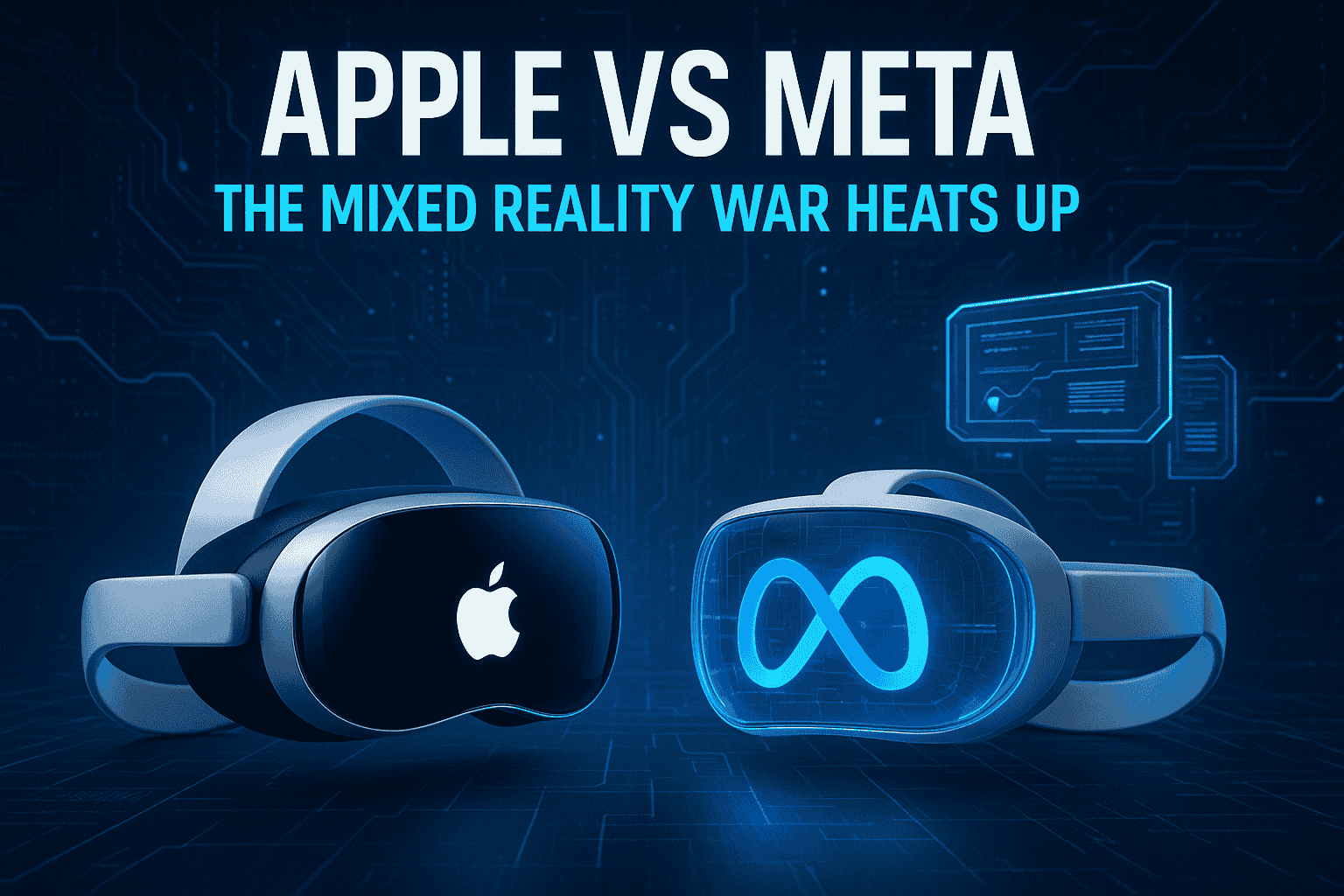
Apple vs Meta: The Mixed Reality War Heats Up
Introduction: The Battle for the Next Digital Frontier
The global technology landscape is undergoing a historic transformation as Apple and Meta engage in what many are calling the next great digital war. This conflict is not about smartphones, social networks, or even computing—it is about redefining reality itself. The race toward dominance in mixed reality (MR) is intensifying, and at its center stands a narrative shaping the future of human interaction with technology: Apple vs Meta: The Mixed Reality War Heats Up.
Mixed reality represents the merging of digital and physical environments, a convergence of augmented reality (AR) and virtual reality (VR) that enables users to interact with digital content as part of their physical world. Both Apple and Meta are investing billions to lead this space, yet their approaches, philosophies, and visions could not be more different. What unfolds between these two giants will define not only market leadership but also the future framework of immersive computing.
The Evolution of Mixed Reality: From Vision to Reality
Mixed reality as a concept has existed for decades, rooted in experimental technology and futuristic imagination. However, it was Meta—formerly Facebook—that brought it into mainstream consciousness. By acquiring Oculus in 2014, Meta laid the foundation for consumer VR and took bold steps toward the metaverse, a digital universe where social interaction transcends physical boundaries.
Over the years, Meta’s Quest series became synonymous with accessible and high-quality virtual experiences. The company focused on affordability, wireless mobility, and social immersion. Each iteration—from the Quest to the Quest 2 and now the Quest 3—pushed the boundaries of what could be achieved within standalone devices, eliminating the need for tethered computers.
Apple, conversely, chose patience and precision. Known for entering markets only when it can deliver a transformative experience, Apple meticulously waited until display technology, sensors, and software integration reached a point where its standards could be met. The result was the Apple Vision Pro, unveiled as a new category of computing—a “spatial computer” designed to merge the digital and physical worlds seamlessly.
Thus, the Apple vs Meta: The Mixed Reality War Heats Up narrative represents not merely a competition of products, but a clash of technological philosophies that have been years in the making.
Apple’s Approach: Precision, Integration, and Experience
Apple’s strategy in mixed reality is consistent with its broader ecosystem philosophy—delivering tightly integrated hardware and software experiences. The Apple Vision Pro stands as a testament to this approach. Built with ultra-high-resolution micro-OLED displays capable of delivering 23 million pixels across two panels, it redefines visual clarity in the MR domain.
Underneath its elegant design lies Apple’s proprietary R1 chip, developed specifically for real-time sensor processing, ensuring minimal latency between real-world perception and digital interaction. Combined with the powerful M2 processor, it offers fluid multitasking, spatial awareness, and immersive rendering capabilities that outclass most consumer-grade headsets.
The real innovation, however, lies in visionOS, Apple’s spatial operating system. Designed around natural user inputs—eyes, hands, and voice—it eliminates the need for controllers. Users can simply look at a digital object, tap their fingers, or speak commands to navigate the environment. The result is a frictionless interface that extends Apple’s design language into an entirely new dimension.
With Vision Pro, Apple is not just building a device—it is constructing the foundation of an ecosystem that connects seamlessly with macOS, iOS, and iPadOS. This integration ensures continuity across devices, creating an immersive experience that feels native, secure, and deeply intuitive.
Meta’s Strategy: Accessibility, Scale, and the Metaverse Vision
While Apple focuses on perfection, Meta is driven by scale. Its vision revolves around democratizing mixed reality and creating an expansive digital world where users can interact, collaborate, and socialize beyond physical constraints.
The Meta Quest 3 represents a significant evolution in that direction. With improved color passthrough, better depth sensing, and lighter hardware, it bridges the gap between augmented and virtual reality. The Quest 3 also boasts a growing library of applications through Meta Horizon Worlds, offering experiences that range from gaming and fitness to remote work and social engagement.
Meta’s philosophy centers on accessibility—both in cost and content. By pricing its hardware at a fraction of Apple’s Vision Pro, Meta aims to reach the largest possible audience. This mass-market approach allows Meta to attract developers, content creators, and businesses into its ecosystem, accelerating adoption across demographics.
Furthermore, Meta’s long-term play lies in the metaverse—a persistent digital layer over reality. Unlike Apple’s closed ecosystem, Meta encourages open development and cross-platform experiences. The company’s ambition is to create a decentralized yet interconnected universe where digital identities, workspaces, and communities thrive independently of traditional operating systems.
Thus, in Apple vs Meta: The Mixed Reality War Heats Up, Meta represents inclusivity and expansion, while Apple symbolizes precision and exclusivity.
Comparing Hardware and Software Ecosystems
In terms of hardware innovation, Apple dominates the premium segment. The Vision Pro’s dual-chip architecture, advanced optics, and precise eye-tracking deliver a near-photorealistic experience unmatched by any competitor. Apple’s commitment to craftsmanship ensures unparalleled visual fidelity and ergonomic design, appealing to creative professionals and enterprise users who demand high-performance solutions.
Meta, however, excels in building flexible, user-friendly hardware that emphasizes affordability and modular development. The Quest 3 integrates Qualcomm’s XR2 Gen 2 chipset, balancing performance and cost-effectiveness while maintaining comfort and portability.
From a software standpoint, Apple’s strength lies in vertical integration. Its tight control over hardware and software results in optimized performance, minimal latency, and seamless synchronization. Meta, on the other hand, focuses on openness—encouraging third-party developers to innovate freely within its platforms, thereby fostering rapid ecosystem growth.
Both companies understand that the future of mixed reality is not defined solely by hardware specifications but by the experiences that ecosystems enable.
User Experience and Design Philosophy
When analyzing user experience, Apple’s approach mirrors its design heritage—minimalism, elegance, and intuitiveness. Vision Pro is marketed as a personal spatial computer, enabling users to work, watch, and communicate within a digital environment that feels natural. Every gesture, gaze, and sound is part of a fluid interaction loop, reflecting Apple’s deep commitment to human-centric design.
Meta’s Quest devices, conversely, prioritize immersion and community. They are designed to enable social interaction, gaming, and collaborative virtual experiences. The company’s focus on comfort, accessibility, and multi-user connectivity demonstrates a commitment to making mixed reality a shared experience rather than a solitary one.
This distinction in design philosophy underscores the fundamental divergence in Apple vs Meta: The Mixed Reality War Heats Up. Apple sees MR as an extension of personal productivity and creativity; Meta envisions it as the next evolution of collective digital life.
Market Dynamics and Consumer Reception
From a market perspective, Apple’s entry with Vision Pro has redefined the perception of what mixed reality can achieve. Although the device’s price places it beyond the reach of mainstream consumers, it signals a paradigm shift toward spatial computing. For developers, content creators, and enterprise users, the Vision Pro offers new possibilities for immersive applications in design, healthcare, and entertainment.
Meta continues to dominate in unit sales, leveraging its early start and competitive pricing. The Quest lineup remains the most accessible entry point into mixed reality, appealing to gamers, educators, and businesses. The company’s success in maintaining steady adoption proves that accessibility can often outweigh perfection in driving innovation at scale.
Together, these two forces are expanding the global MR ecosystem, propelling new startups, software solutions, and user experiences.
The Economic and Technological Ripple Effect
The implications of the Apple vs Meta: The Mixed Reality War Heats Up extend far beyond the companies themselves. As Apple and Meta push the boundaries of spatial computing, industries such as retail, real estate, healthcare, and education are being transformed.
In Mumbai, a growing hub for technology and innovation, mixed reality is emerging as a frontier for digital entrepreneurship. From architecture firms using immersive design tools to educational institutions adopting virtual classrooms, the impact is tangible. Apple’s Vision Pro may cater to elite professionals and developers, while Meta’s Quest series provides accessible entry points for small enterprises and content creators experimenting with immersive storytelling.
Globally, the competition drives innovation across the supply chain—from semiconductor design and optical engineering to user interface development and AI-driven motion tracking.
Future Outlook: Collaboration, Competition, and Convergence
The future of mixed reality will likely witness both competition and convergence. While Apple continues refining its premium ecosystem, Meta will keep democratizing access through scalable, open solutions. Eventually, both may coexist within a broader landscape of spatial computing—each serving distinct segments of users and industries.
The next decade will determine whether the dominant paradigm favors Apple’s vertically integrated precision or Meta’s socially driven expansiveness. What remains certain is that the battle between these two tech titans will accelerate the mainstream adoption of mixed reality technologies worldwide.
As Apple vs Meta: The Mixed Reality War Heats Up, it becomes increasingly evident that this is not just a contest for market share—it is a struggle to define the very nature of human–machine interaction in the 21st century.
Conclusion: Redefining Reality in the Age of Immersion
The Apple vs Meta: The Mixed Reality War Heats Up saga represents more than a rivalry; it symbolizes humanity’s transition from digital observation to digital immersion. Apple’s pursuit of perfection and Meta’s quest for inclusivity are shaping a future where reality itself is reimagined.
In this unfolding technological revolution, both companies contribute to expanding human potential. Whether through Apple’s precision-crafted experiences or Meta’s socially integrated ecosystems, the world stands on the brink of a new digital dimension—one that blurs the boundaries between imagination and experience, presence and perception, the physical and the virtual.
Explore More from Intellitron Genesis
Continue exploring the evolving landscape of technology, innovation, and digital transformation through our latest blogs on Intellitron Genesis:
- FinTech Startups: Redefining Banking in Emerging Markets
- Why Metaverse Search Interest Dropped Then Rose Again
- What It Takes to Become a Web3 Developer in 2025
- How Digital Sovereignty Laws Will Reshape Global Tech Markets
- Intel’s Activist Investor Shakes Up Tech Leadership
