
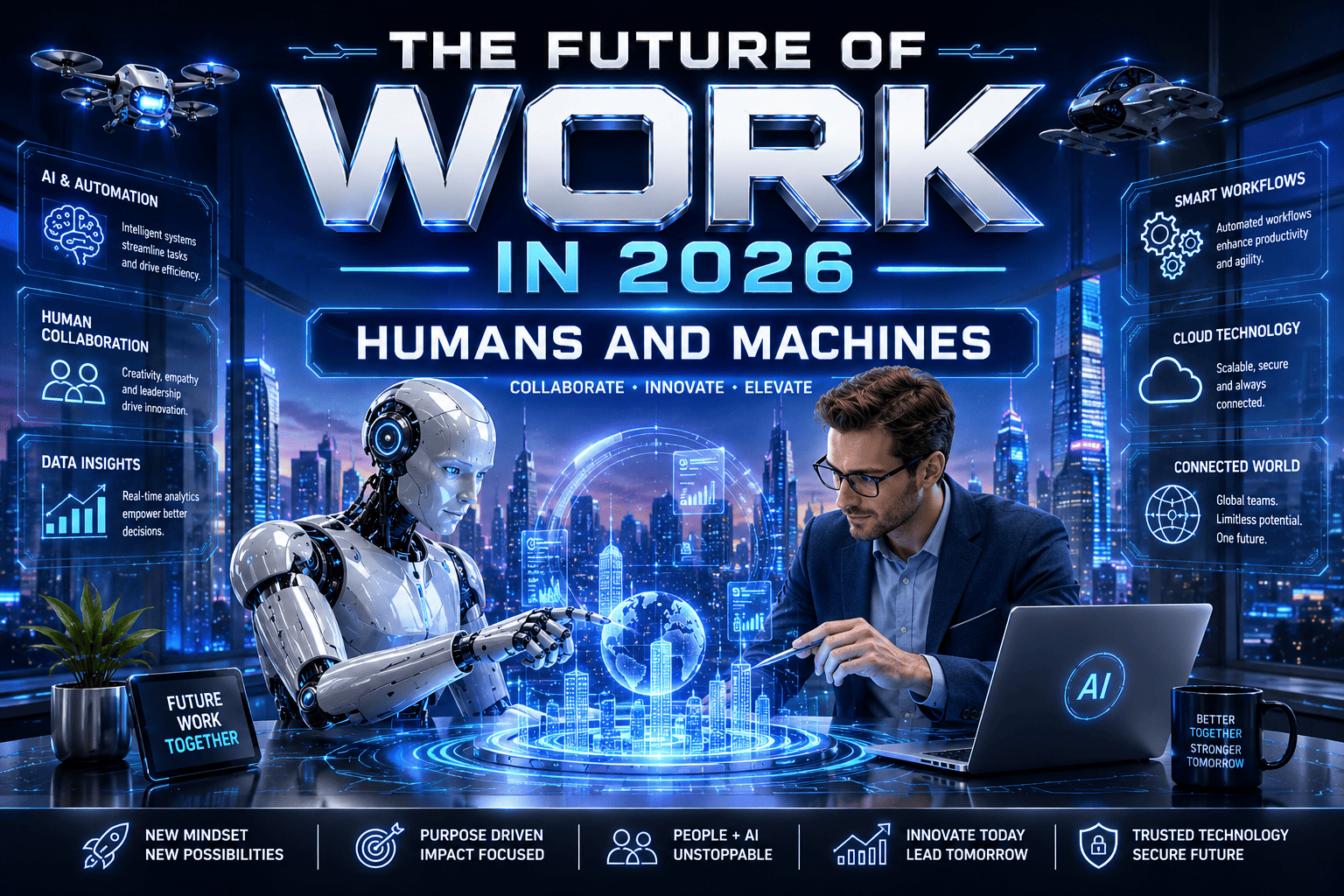
The Future of Work in 2026: Humans and Machines
The Future of Work in 2026: Humans and Machines – Redefining Productivity, Innovation, and Human Potential
As we stand on the cusp of a technological revolution, The Future of Work in 2026 promises a landscape where humans and machines collaborate seamlessly, reshaping industries, redefining skills, and transforming the global economy. Across boardrooms, manufacturing facilities, healthcare institutions, educational organizations, logistics networks, and digital enterprises, conversations about The Future of Work in 2026 are becoming increasingly important. The workplace is evolving faster than at any other point in modern history, driven by unprecedented advances in artificial intelligence, automation, robotics, cloud computing, data analytics, and digital transformation.
The concept of The Future of Work in 2026: Humans and Machines extends far beyond technological upgrades or workplace digitization. It represents a fundamental shift in how organizations operate, how employees contribute value, and how innovation is created. Businesses worldwide are entering a new era where intelligent systems are no longer simply tools but active collaborators capable of assisting with decision-making, automating routine tasks, identifying opportunities, and enhancing human performance.
For decades, experts predicted that automation would transform the workforce. However, The Future of Work in 2026 demonstrates that the conversation is not about humans versus machines. Instead, it is about humans and machines working together in increasingly sophisticated ways. Organizations are recognizing that technology alone cannot solve complex business challenges. Human creativity, emotional intelligence, leadership, strategic thinking, and ethical judgment remain indispensable. The most successful enterprises in The Future of Work in 2026 will be those that combine machine efficiency with uniquely human capabilities.
The acceleration of AI in workplace environments has amplified both excitement and concern. Some professionals worry that intelligent automation may replace traditional jobs. Others see tremendous opportunities emerging through workforce transformation, new career paths, and enhanced productivity. Understanding The Future of Work in 2026 therefore becomes essential for executives, entrepreneurs, educators, policymakers, and professionals seeking to remain competitive in an increasingly digital economy.
Several converging trends are shaping The Future of Work in 2026. Artificial intelligence is becoming embedded in daily workflows. Automation is streamlining repetitive processes. Robotics is expanding beyond manufacturing into healthcare, retail, agriculture, and logistics. Remote and hybrid work models are redefining workplace flexibility. Meanwhile, the demand for future skills continues to grow as organizations seek employees capable of adapting to constant change.
What makes The Future of Work in 2026: Humans and Machines particularly significant is the emergence of human-machine collaboration as a central pillar of business success. Machines can process enormous volumes of data, identify patterns, and execute repetitive tasks with remarkable efficiency. Humans contribute creativity, empathy, critical thinking, leadership, and innovation. Together, they form a partnership capable of achieving outcomes neither could accomplish independently.
As businesses continue their digital transformation journeys, understanding The Future of Work in 2026 is no longer optional. Organizations that prepare effectively will gain competitive advantages, attract top talent, accelerate innovation, and build resilient business models capable of thriving in an increasingly dynamic marketplace.
This comprehensive analysis explores the technological, economic, and social forces driving The Future of Work in 2026, examines the evolving role of human workers, investigates the growing capabilities of intelligent machines, addresses emerging challenges, and provides actionable strategies for organizations and individuals preparing for the next era of workforce transformation.
Understanding The Future of Work in 2026
The phrase “The Future of Work in 2026” has become one of the most discussed topics among business leaders, economists, technology experts, and workforce strategists. While previous industrial revolutions transformed physical labor, The Future of Work in 2026 focuses on transforming knowledge work, decision-making processes, collaboration models, and organizational structures.
Unlike earlier technological shifts, today’s transformation is occurring simultaneously across multiple industries. Artificial intelligence, machine learning, automation, robotics, cybersecurity, cloud computing, blockchain, augmented reality, and advanced analytics are converging to create a new workplace ecosystem.
Several key characteristics define The Future of Work in 2026:
Intelligent Automation Everywhere
Automation is no longer limited to manufacturing plants and assembly lines. In The Future of Work in 2026, intelligent automation extends across virtually every business function.
Organizations increasingly automate:
- Financial operations
- Human resource management
- Customer support
- Sales processes
- Supply chain management
- Compliance reporting
- Marketing operations
- Data management
The objective is not merely cost reduction. Businesses are leveraging automation to improve accuracy, accelerate workflows, reduce human error, and allow employees to focus on strategic activities.
Data-Driven Decision Making
One of the defining aspects of The Future of Work in 2026 is the growing importance of data as a strategic asset.
Organizations generate unprecedented volumes of information from:
- Customer interactions
- Business transactions
- IoT devices
- Social platforms
- Enterprise systems
- Market intelligence tools
Artificial intelligence enables businesses to transform raw information into actionable insights. This capability empowers leaders to make faster and more informed decisions, strengthening organizational agility and competitiveness.
Workforce Transformation Accelerates
Workforce transformation is perhaps the most visible outcome of The Future of Work in 2026.
Traditional job descriptions are evolving rapidly. Many positions now require a combination of technical expertise, digital literacy, and interpersonal skills. Employees must continuously adapt as new technologies reshape workflows and create entirely new categories of work.
Organizations are increasingly investing in:
- Upskilling initiatives
- Reskilling programs
- Digital literacy training
- Leadership development
- AI competency programs
This investment reflects a growing recognition that people remain the most valuable asset in the digital economy.
The Rise of the Digital Economy
The digital economy forms the foundation of The Future of Work in 2026.
Businesses increasingly operate through digital platforms, cloud infrastructures, virtual collaboration systems, and online marketplaces. Geographic boundaries are becoming less relevant as organizations access talent, customers, and partners across the globe.
As a result, professionals must develop competencies that enable success within digitally connected environments, including remote collaboration, virtual leadership, digital communication, and technological adaptability.
Human-Machine Collaboration as the New Standard
Perhaps the most important characteristic of The Future of Work in 2026 is the normalization of human-machine collaboration.
Rather than replacing workers, advanced technologies are augmenting human capabilities.
Examples include:
- AI-powered research assistants
- Intelligent project management systems
- Predictive analytics platforms
- Automated coding assistants
- Smart manufacturing systems
- Clinical decision-support tools
- AI-driven customer engagement platforms
These technologies enable employees to perform their jobs more efficiently while focusing on high-value activities that require human judgment and creativity.
The organizations that thrive in The Future of Work in 2026 will not be those that simply adopt technology. They will be the organizations that successfully integrate human expertise and machine intelligence into a unified operating model capable of driving continuous innovation and sustainable growth.

0 comments