
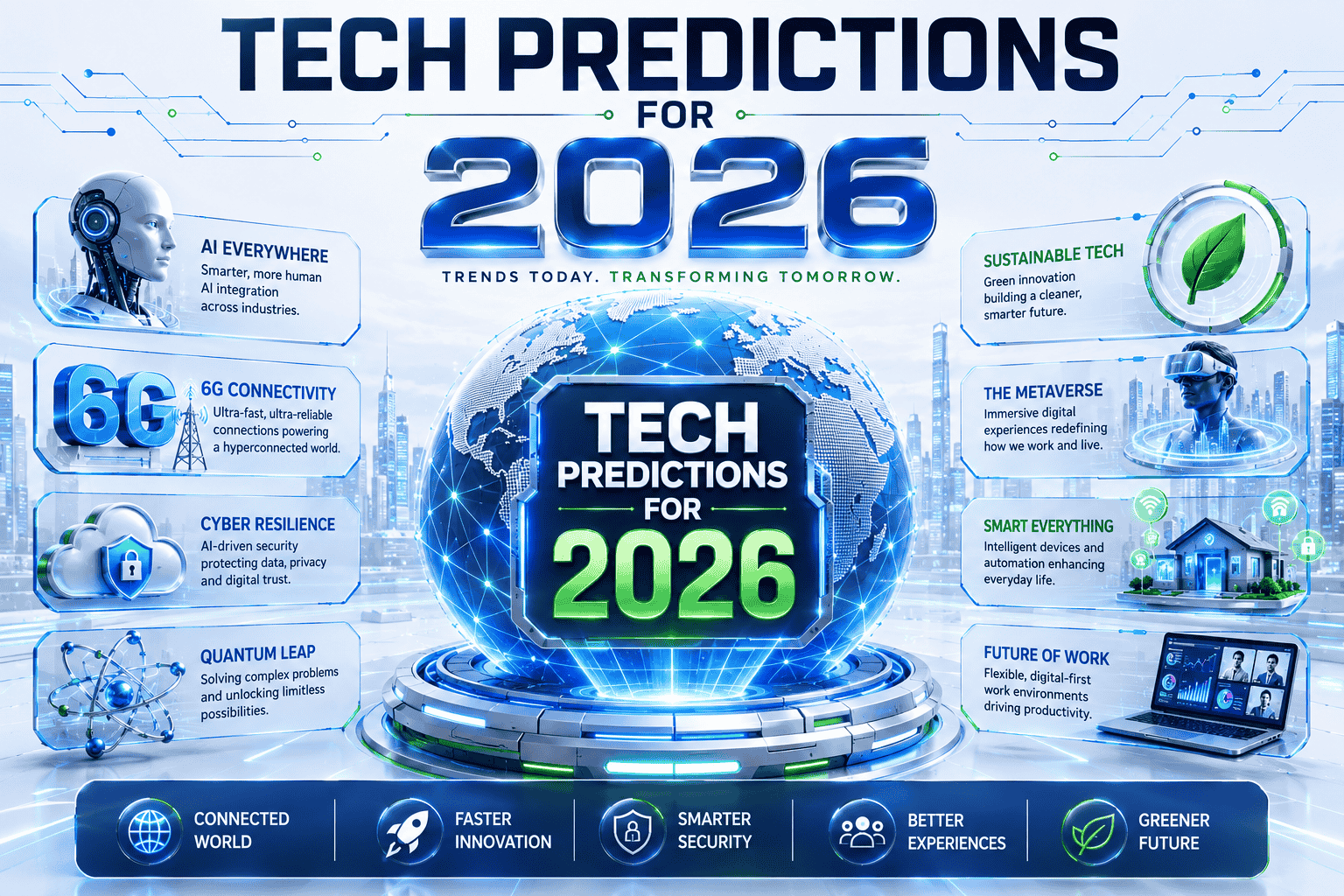
Tech Predictions for 2026: What Analysts Got Right and Wrong
Tech Predictions for 2026: Separating Vision from Reality
Technology evolves faster than almost any other force shaping modern society. Over the last decade, breakthroughs in artificial intelligence, cloud computing, robotics, cybersecurity, renewable energy, spatial computing, and connected devices have transformed how businesses operate and how individuals interact with the world. As 2026 unfolds, many of the bold forecasts made years ago are now being tested against reality.
The discussion around Tech Predictions for 2026 has become increasingly relevant as organizations evaluate investment strategies, governments develop technology regulations, and consumers adapt to new digital experiences. Every year, analysts, futurists, research firms, and technology companies release ambitious forecasts about what the future of tech will look like. Some predictions prove remarkably accurate, while others fail to account for technical limitations, market realities, economic conditions, or human behavior.
Understanding which Tech Predictions for 2026 were accurate—and which missed the mark—provides valuable insight into how technological innovation actually unfolds. More importantly, it helps businesses, entrepreneurs, investors, and technology enthusiasts develop a more realistic framework for evaluating future trends.
In this comprehensive analysis, Intellitron Genesis examines the most influential Tech Predictions for 2026, evaluates what analysts got right, identifies where forecasts fell short, and explores what these lessons reveal about the future of technology.
For readers seeking additional perspectives on emerging technologies, digital transformation, artificial intelligence, and future innovation, we recommend exploring related articles available through the Intellitron Genesis blog at https://intellitrongenesis.com/blog.
The Evolution of Tech Predictions for 2026
Long before 2026 arrived, industry analysts projected transformative developments across multiple technology sectors.
Major consulting firms, research organizations, and technology leaders predicted significant progress in:
- AI advancements and automation
- Quantum computing
- Autonomous vehicles
- 5G and emerging 6G networks
- Augmented Reality (AR)
- Virtual Reality (VR)
- Internet of Things (IoT)
- Blockchain applications
- Renewable energy technology
- Robotics and intelligent manufacturing
- Cybersecurity automation
- Digital healthcare innovation
Many forecasts suggested that by 2026, society would experience unprecedented levels of automation, immersive digital experiences, and machine-driven decision-making.
While some of these expectations materialized faster than anticipated, others encountered practical barriers that delayed widespread adoption.
The reality of Tech Predictions for 2026 demonstrates an important truth: technological progress rarely follows a straight line.
What Analysts Got Right About Tech Predictions for 2026
AI Advancements Became the Defining Technology Trend
Perhaps the most accurate component of nearly every 2026 technology forecast involved artificial intelligence.
Analysts correctly anticipated that AI would move beyond experimentation and become deeply integrated into everyday business operations.
Today, AI powers:
- Customer service automation
- Content generation
- Software development
- Healthcare diagnostics
- Financial analysis
- Supply chain optimization
- Cybersecurity monitoring
- Personalized marketing
Generative AI systems transformed productivity across industries by enabling organizations to automate repetitive tasks while enhancing creative workflows.
Businesses that once viewed AI as an emerging technology now consider it a strategic necessity.
Why This Prediction Was Accurate
Several factors accelerated AI adoption:
Increased Computing Power
Cloud infrastructure providers dramatically expanded access to high-performance computing resources, making advanced AI models more accessible.
Improved Data Availability
Organizations generated unprecedented volumes of structured and unstructured data, providing the fuel necessary for machine learning systems.
Commercial Viability
Unlike many emerging technologies, AI demonstrated immediate return on investment through efficiency gains and operational improvements.
Enterprise Integration
Major software platforms integrated AI capabilities directly into workflows, reducing barriers to adoption.
As a result, AI advancements became one of the most successful Tech Predictions for 2026.
Smart Devices and IoT Expansion Accelerated
Another accurate forecast involved the continued growth of connected devices.
Analysts predicted that billions of smart devices would become integrated into homes, cities, factories, and healthcare systems.
This prediction largely came true.
The modern Internet of Things ecosystem now includes:
- Smart home assistants
- Connected appliances
- Industrial sensors
- Wearable health devices
- Smart energy systems
- Connected transportation infrastructure
Organizations increasingly rely on real-time data generated by IoT networks to improve efficiency and decision-making.
Impact on Business Strategy
Businesses leverage IoT technology to:
- Reduce operational costs
- Predict equipment failures
- Improve customer experiences
- Optimize logistics
- Enhance workplace safety
The success of connected technologies confirms that IoT remains one of the most influential technology trends shaping the future of tech.
Renewable Energy Technology Advanced Faster Than Expected
One of the more surprising successes among Tech Predictions for 2026 involves renewable energy innovation.
While technology forecasts often focus on software and computing, energy technology has experienced substantial progress.
Significant developments include:
- Improved battery storage systems
- More efficient solar technologies
- Advanced grid management platforms
- AI-powered energy optimization
- Electric vehicle infrastructure expansion
Governments and corporations increasingly prioritize sustainability initiatives, accelerating investment in clean energy technologies.
This demonstrates how innovation often emerges at the intersection of digital technology and environmental responsibility.
AI-Powered Cybersecurity Became Essential
Cybersecurity experts predicted that traditional security models would struggle to defend against increasingly sophisticated threats.
That prediction proved accurate.
Modern organizations now use AI-driven security platforms capable of:
- Detecting anomalies
- Identifying threats in real time
- Automating incident response
- Monitoring network activity continuously
As cyberattacks became more complex, automation became a necessity rather than an advantage.
This trend highlights how AI advancements continue to influence nearly every area of technology.
What Analysts Got Wrong About Tech Predictions for 2026
Fully Autonomous Vehicles Did Not Become Mainstream
Among the most widely discussed Tech Predictions for 2026 was the expectation that fully autonomous vehicles would dominate roads worldwide.
Many analysts projected widespread Level 5 autonomy by the mid-2020s.
That prediction did not materialize.
Although autonomous driving technology improved significantly, widespread deployment remains limited.
Why Analysts Overestimated Adoption
Several challenges slowed progress:
Regulatory Complexity
Governments continue developing frameworks for liability, safety, and certification.
Edge Cases
Autonomous systems still struggle with rare or unpredictable driving scenarios.
Public Trust
Consumers remain cautious about fully driverless transportation.
Infrastructure Requirements
Many regions lack the infrastructure needed to support large-scale autonomous mobility.
The lesson is clear: technological capability alone does not guarantee adoption.
Quantum Computing Remained Largely Experimental
Another area where analysts misjudged timelines involves quantum computing.
Earlier forecasts suggested that by 2026, quantum systems would begin solving mainstream business problems at scale.
While impressive breakthroughs occurred, practical quantum computing remains largely confined to research environments and specialized applications.
What Analysts Underestimated
They underestimated:
- Error correction challenges
- Hardware complexity
- Scalability limitations
- Commercial deployment barriers
Quantum computing remains promising, but its widespread business impact is likely further away than many predicted.
The Metaverse Did Not Become the Primary Digital Platform
Several years ago, analysts predicted immersive virtual worlds would become the next major evolution of the internet.
Although AR and VR technologies improved substantially, adoption did not reach the levels many forecasts anticipated.
Organizations discovered that users preferred practical applications over fully immersive digital lifestyles.
Successful implementations focused on:
- Enterprise training
- Industrial simulations
- Education
- Design collaboration
- Remote assistance
This illustrates an important lesson about forecasting technology trends: consumer behavior often evolves differently than expected.
Why Technology Forecasts Often Miss the Mark
Innovation Is Nonlinear
Technological development rarely progresses at a predictable pace.
Breakthroughs can accelerate unexpectedly, while seemingly inevitable innovations may stall for years.
Human Behavior Matters
Many analysts focus on technical feasibility while underestimating human adoption patterns.
Technology succeeds only when users find meaningful value.
Regulation Influences Outcomes
Government policies increasingly shape the future of tech.
Privacy laws, AI regulations, cybersecurity standards, and competition policies significantly affect innovation timelines.
Economic Conditions Change
Global economic uncertainty can delay technology investments and slow adoption rates.
Even transformative innovations require favorable market conditions to scale successfully.
Emerging Lessons from Tech Predictions for 2026
Several important insights emerge when examining successful and unsuccessful forecasts.
Focus on Infrastructure
Technologies supported by strong infrastructure tend to scale more effectively.
Prioritize Practical Value
Solutions that address real-world problems gain traction faster than technologies driven primarily by hype.
Expect Gradual Adoption
Revolutionary technologies often become mainstream through incremental improvements rather than sudden disruption.
Monitor Ecosystem Development
Innovation depends on partnerships, regulations, standards, and complementary technologies.
Looking Beyond 2026: The Next Wave of Innovation
As we evaluate Tech Predictions for 2026, attention naturally shifts toward what comes next.
Several sectors appear positioned for significant breakthroughs.
Agentic AI and Autonomous Digital Workers
The next evolution of AI advancements will involve intelligent systems capable of executing multi-step workflows independently.
Businesses are already experimenting with AI agents that can:
- Conduct research
- Analyze data
- Generate reports
- Coordinate business processes
Robotics and Physical AI
Advances in machine perception and AI reasoning are accelerating the development of intelligent robotics.
Industries likely to benefit include:
- Manufacturing
- Logistics
- Healthcare
- Agriculture
- Construction
Advanced Healthcare Technologies
The convergence of AI, biotechnology, genomics, and wearable devices could fundamentally reshape healthcare delivery.
Sustainable Technology Innovation
Clean energy, carbon management, battery storage, and smart infrastructure will remain major areas of investment.
Spatial Computing
Although early metaverse expectations were overstated, spatial computing continues evolving and may eventually redefine human-computer interaction.
Final Thoughts: What Tech Predictions for 2026 Teach Us
The story of Tech Predictions for 2026 is ultimately a story about balancing optimism with realism.
Analysts correctly identified transformative trends such as AI advancements, smart device proliferation, cybersecurity automation, and renewable energy innovation. These developments have reshaped industries and created new opportunities across the global economy.
At the same time, forecasts surrounding autonomous vehicles, quantum computing, and immersive virtual worlds often underestimated the complexity of real-world adoption. Technical challenges, regulatory frameworks, economic considerations, and human behavior all played critical roles in shaping outcomes.
The most important lesson is not whether a prediction was entirely right or wrong. Rather, it is understanding why certain technologies accelerated while others lagged behind expectations.
As we move beyond 2026, organizations that combine technological awareness with strategic adaptability will be best positioned to capitalize on emerging opportunities. The future of tech will continue to evolve rapidly, rewarding those who critically evaluate forecasts rather than accepting them at face value.
Stay connected with Intellitron Genesis for ongoing analysis of technology trends, AI advancements, digital transformation, and future innovation. Explore additional insights through our growing knowledge resources and continue challenging assumptions about what tomorrow’s technology landscape may hold.
The future is rarely predicted perfectly—but understanding the patterns behind successful predictions may be the most valuable forecast of all.
Read More:
- Future of Work in 2026: Humans and Machines
- Apple vs Meta: The Mixed Reality War Heats Up
- The Future of Cybersecurity: Trends and Strategies for IT Solutions Providers
- Global 5G Politics: Why Spectrum Is a Battleground
- AI in 2026: What Changed After the Generative AI Boom
- Layoffs in Tech: What Search Data Reveals About Anxiety
